How to show up in AI search
You probably won’t be surprised by the most common question I get from clients and prospects.
It’s some version of “What about AI?” — especially when we’re talking about search and discoverability.
Here’s what my SEO partners and I are seeing right now when it comes to getting your business included in AI search and chat results:
1) Start with solid SEO
Before we talk about AI, it’s worth remembering what good SEO actually entails.
The effort behind any request to “rank higher on Google” goes into things like:
Making it clear what you do and who you serve
Publishing helpful, specific content around real customer questions
Demonstrating experience and expertise in your niche
Keeping your site technically clean and easy to crawl
Those same ingredients are what AI systems look for when they scan the web.
Google has said that AI Overviews and AI Mode pull from relevant, high‑quality results in their existing index — they aren’t running a totally separate universe.
ChatGPT and Perplexity also rely on web retrieval and cited sources, not some intuitive understanding of your business.
So when you invest in SEO fundamentals — clear positioning, useful content, solid site structure — you’re doing double duty:
You make it easier for humans to find and understand you in classic search.
And you make it easier for AI to confidently use you as a source.
That’s why I still see SEO as the best foundation, even if the exact way you show up in search results is changing.
2) Be present on popular websites
Once your own site is in good shape, the next layer is to show up in other places your audience — and the models — already trust.
For a small service business, that doesn’t have to mean a big PR campaign. It can look like:
An up‑to‑date LinkedIn company page and personal profile
Reviews on the obvious platforms in your space
Guest articles, podcast appearances, or association spotlights
Mentions on partner sites or local business directories
Traditionally, a lot of this was about backlinks and citations to support Google’s search index.
But now there’s an extra upside: AI is fantastic at semantics. It’s very good at reading and understanding the stories being told about you.
If the way you describe your business is echoed — in plain language — on your site, on LinkedIn, in a few reviews, and in one or two articles, you’re making it easier for AI to piece together who you are and what you’re good at.
Think of it as reinforcing your positioning around the web. It doesn’t have to be a chase to reach every new platform.
3) No one has a great way to measure AI search results… yet
This part is messy.
The best research I’ve seen on this is from Rand Fishkin at SparkToro:
Despite the hundreds of millions of dollars poured into AI tracking and visibility, AI tools are highly inconsistent when recommending brands and products, so any “AI ranking” should be treated with skepticism.
Plus, while Google Search Console includes clicks and impressions from AI Overviews and AI Mode in its standard reporting, as of this writing, it still doesn’t separate them from regular organic search results.
So what can you do?
We run anecdotal searches and see whether clients are mentioned. We watch for referral traffic from ChatGPT and other tools. We assume: if we’re seeing some traffic, we’re probably getting more visibility than the numbers show, because most people don’t click every citation.
We also love when our clients ask their clients, “How did you hear about us?”
Yeah, it’s not perfect. And it’s fuzzy. But fuzzy doesn’t mean “nothing is happening.” It just means we shouldn’t pretend to have precision we don’t.
Learn to love qualitative feedback.
—
4) Positioning and messaging are more important than ever
Our goal is not just to get clients named and cited in AI results.
We want them to be described accurately and favourably, so those results actually help them close business.
That’s where positioning and messaging really matter.
If your website is vague, your offer is muddy, and your ‘differentiators’ sound like everyone else’s, AI has very little to work with. It might still find you, but the way it describes you will be generic.
If your message is clear and repeated consistently — on your site, on LinkedIn, in reviews and write‑ups — you increase the odds that AI mirrors the story you actually want told.
Here’s what that looks like:
Google’s AI Overview describes cityHUNT as being the “Best for Corporate Customization & Large Scale” in New York:
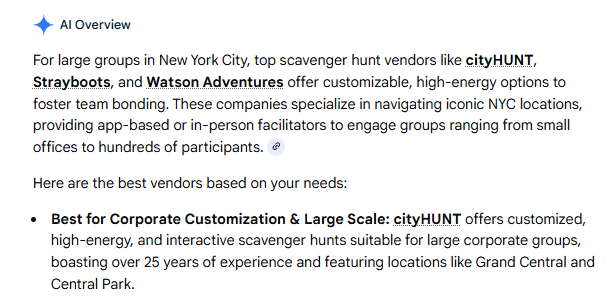
ChatGPT notes Third Rock Geomatics’ 3-5 day turnaround time for Real Property Reports in Calgary, calling them “Best for: speed + smooth closings”:

In both cases, the AI looks like it was reading from our Positioning Canvas.
Ugh, it makes me so happy. Everything in alignment.
—
Anyway, this blog is not as sexy as a list of “AI optimization hacks.”
But there’s nothing we’ve seen that suggests AI discoverability should be treated as some separate, mysterious discipline.
The best foundation looks familiar:
A technically sound website
Useful, well‑optimized content
Clear positioning
Consistent messaging
Credible mentions across the broader web
And that’s what seems to be working.
I hope this helps.
All the best,
Justin
This article originally appeared in our newsletter. Subscribe here.